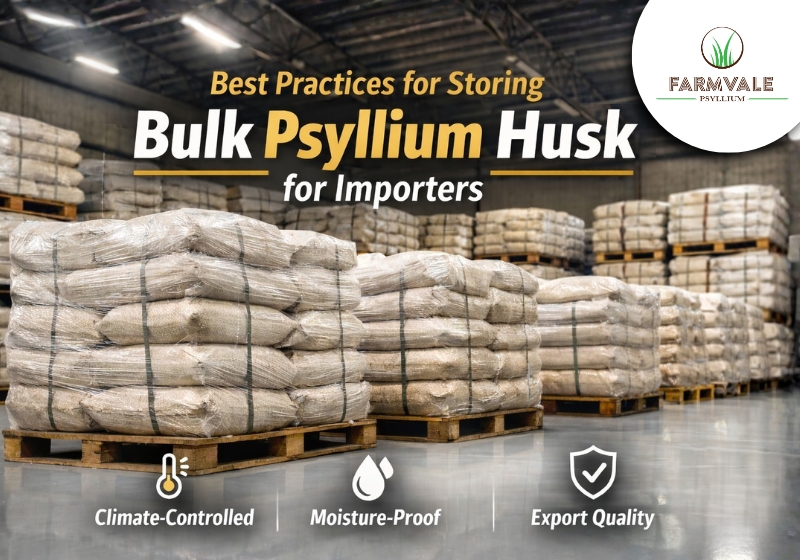
Best Practices for Storing Bulk Psyllium Husk for Importers
The global demand for psyllium husk is rapidly increasing across the nutraceutical, pharmaceutical, and functional food industries. Importers sourcing from leading psyllium husk exporters in India must focus not only on product sourcing but also on maintaining the correct bulk psyllium husk storage conditions to protect product quality.
India is the world’s largest producer and exporter of psyllium, supplying high-quality natural dietary fiber ingredients to international markets. Because psyllium is a highly absorbent soluble fiber, improper storage can reduce its effectiveness, impact texture, and shorten the psyllium husk shelf life.
To maintain premium quality, importers should follow these essential psyllium husk storage guidelines.
1. Maintain a Controlled Storage Temperature
Temperature plays a crucial role in psyllium fiber storage. Excessive heat can degrade the natural fiber structure and reduce its gel-forming properties.
For optimal bulk psyllium husk storage, warehouses should maintain temperatures below 25°C (77°F).
Proper temperature management helps:
- Preserve the functional fiber quality
- Maintain psyllium husk purity and texture
- Prevent microbial growth during long-term storage
Importers dealing with large psyllium husk shipments should ideally use temperature-controlled storage facilities to ensure consistent quality.
2. Control Humidity to Prevent Moisture Damage
Moisture control is one of the most important factors in psyllium husk quality control. Psyllium naturally absorbs moisture from the environment, which can lead to clumping and microbial contamination.
For safe psyllium husk storage, the warehouse humidity level should remain below 60–65%.
Best practices include:
- Using moisture-resistant psyllium husk packaging
- Installing warehouse dehumidifiers
- Storing pallets away from walls and floors
- Maintaining dry, ventilated storage environments
Proper humidity control helps preserve the natural swelling capacity of psyllium fiber, which is essential for food and pharmaceutical applications.
3. Use Export-Grade Psyllium Husk Packaging
High-quality psyllium husk packaging protects the product from moisture, contamination, and air exposure during global shipping and storage.
Leading psyllium husk suppliers commonly use:
- Multi-layer laminated bags
- Food-grade HDPE export bags
- Kraft paper bags with inner liners
These packaging materials are specifically designed for bulk psyllium export shipments, ensuring the fiber maintains its quality during international transportation.
Palletized packaging with stretch wrapping further protects shipments during logistics handling.
4. Protect Psyllium Husk from Direct Sunlight
Exposure to sunlight and heat can reduce the stability of natural psyllium fiber products.
For effective psyllium husk warehouse storage, importers should:
- Store psyllium in shaded warehouse areas
- Avoid direct sunlight exposure
- Keep products away from heat sources
Maintaining dark and cool environments helps preserve psyllium husk color, purity, and functional performance.
5. Monitor Psyllium Husk Shelf Life
Under proper storage conditions, bulk psyllium husk typically has a shelf life of 2–3 years, while psyllium powder products usually last 1–2 years.
Importers should implement the FIFO (First-In, First-Out) inventory method to ensure that older batches are distributed before newer stock.
Routine quality inspections should check for:
- Consistent color
- Neutral aroma
- Free-flowing fiber texture
These steps help maintain high-quality psyllium supply chains for global markets.
6. Maintain Hygienic Warehouse Conditions
Clean storage environments are essential for maintaining food-grade psyllium husk quality. Importers supplying nutraceutical or pharmaceutical industries must ensure strict warehouse hygiene.
Important hygiene measures include:
- Pest-free storage areas
- Clean palletized storage systems
- Proper ventilation and airflow
- Compliance with international food safety standards
Working with trusted psyllium husk exporters in India ensures consistent product quality and adherence to global quality certifications.
Conclusion
Proper storage plays a vital role in maintaining the quality, functionality, and shelf life of bulk psyllium husk. Importers who implement temperature control, moisture management, high-quality packaging, and inventory monitoring can significantly reduce product loss and maintain consistent supply quality.
With the rising global demand for natural dietary fibers, adopting these best practices for its storage ensures that the product remains safe, effective, and ready for use across food, nutraceutical, and pharmaceutical applications.
Farmvale Psyllium is committed to delivering premium-quality psyllium products sourced directly from India’s leading psyllium-growing regions. With a focus on quality control, modern processing, and export-grade packaging, the company supports global importers with reliable psyllium supply solutions.