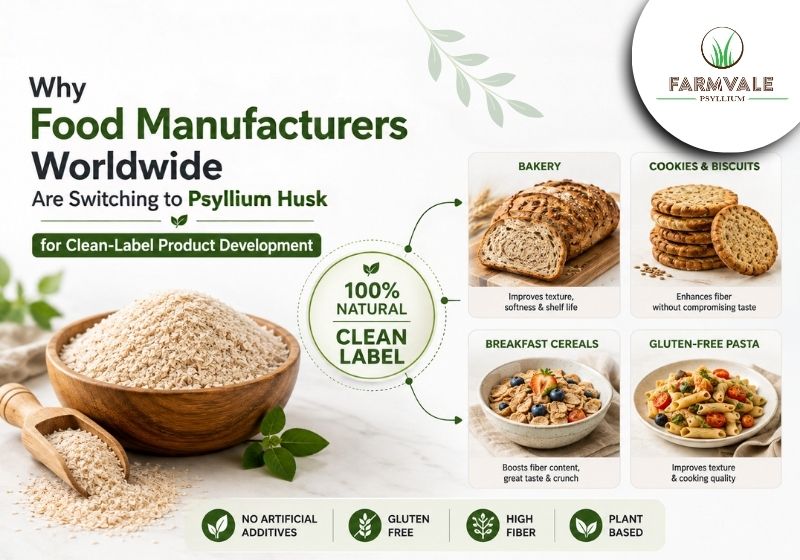
Why Food Manufacturers Worldwide Are Switching to Psyllium Husk for Clean-Label Product Development
Food manufacturers are increasingly evaluating psyllium husk as a versatile, fiber-rich ingredient for clean-label product development. It can support fiber enrichment and formulation performance across bakery products, snacks, breakfast foods, beverages and other functional food categories, while fitting consumer demand for recognizable, nutrition-focused ingredients.
Why Is Psyllium Husk Becoming Important for Food Manufacturers?
Consumers are paying closer attention to ingredient lists and looking for products that combine nutrition, convenience and simple positioning. Recent food-industry trend research highlights naturalness, enhanced nutrition, protein and fiber, with gut-health innovation increasingly centered on fiber and prebiotic concepts. Psyllium husk fits this direction because it is a plant-derived source of dietary fiber with useful functional properties.
What Makes Psyllium Husk Suitable for Clean-Label Product Development?
Psyllium husk is the outer covering of Plantago ovata seeds. In food formulation, its high fiber content and water-binding characteristics can make it useful for improving texture, structure and fiber content in selected formulations. The exact performance depends on particle size, purity, dosage, processing conditions and the rest of the recipe.
Key Food Applications
- Bakery: Product developers can evaluate psyllium in breads, buns, gluten-free bakery products, crackers, and other baked goods where fiber enrichment and structure matter.
- Breakfast & cereals: Manufacturers can incorporate psyllium into granola, cereal blends, and nutrition-focused breakfast products.
- Snacks: Manufacturers can explore psyllium in fiber-rich bars, baked snacks, and other convenient formats.
- Beverages & mixes: Product developers can use psyllium in selected powdered drink mixes and functional formulations, subject to hydration and sensory requirements.
- Dairy and plant-based foods: Product developers can consider psyllium for certain yogurt, smoothie, and plant-based formulations where they want to improve texture and support fiber positioning.
What Should Product Developers Check Before Buying Psyllium Husk?
Manufacturers should assess botanical identity, purity, microbiological quality, heavy metals and pesticide controls where applicable, particle size, hydration behavior, consistency between lots, packaging, traceability and the documentation required for the destination market. Supplier qualification should also consider manufacturing controls, food-safety systems and technical support.
How Does Psyllium Support High-Fiber Product Positioning?
Psyllium is naturally rich in dietary fiber, making it attractive for formulations designed around fiber enrichment. However, the finished product formulation and applicable local regulations determine the final nutrition information and any permitted product claims. Manufacturers should validate nutrition values and labeling before commercialization.
Why Supplier Selection Matters
For commercial-scale production, consistency is as important as ingredient functionality. A qualified supplier should be able to provide a clear specification, certificate of analysis, traceability information, appropriate food-safety documentation and reliable batch-to-batch supply. Buyers should also evaluate export experience and the supplier’s ability to meet destination-market requirements.
Farmvale Psyllium
Farmvale Psyllium supplies psyllium ingredients for international food and industrial applications, with a focus on quality, consistency and export-oriented supply. For product developers, selecting the right grade, specification, and documentation depends on the intended application and destination-market requirements.
Frequently Asked Questions
What is psyllium husk used for in food manufacturing?
Is psyllium husk a clean-label ingredient?
Which food products can contain psyllium husk?
How do manufacturers choose the right psyllium grade?
Can psyllium be used for high-fiber products?