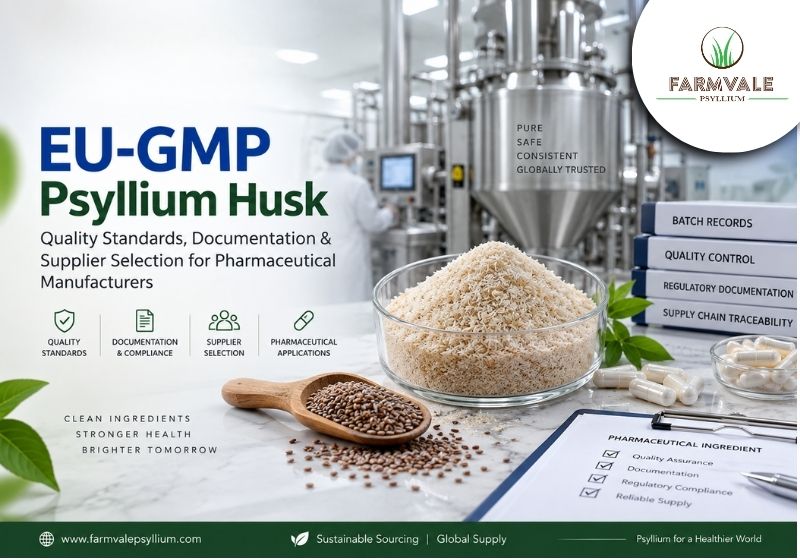
EU-GMP Psyllium Husk: Quality Standards, Documentation & Supplier Selection for Pharmaceutical Manufacturers
Pharmaceutical manufacturers evaluating psyllium husk should treat supplier qualification as a quality-risk process rather than relying on a marketing label such as ‘GMP grade’. EU GMP guidance for excipients emphasizes risk assessment, supplier qualification, appropriate quality systems, documentation, traceability and controls that match the intended use. Buyers should verify the supplier’s actual certifications, controls and documentation for their specific application.
What Does EU-GMP Mean for Psyllium Husk?
EU GMP is the European framework for good manufacturing practice for medicinal products. For excipients, EU guidance requires manufacturers and marketing-authorisation holders to assess and control the risks associated with the excipient supply chain. The level of GMP assurance should be proportionate to the risk and intended use.
Why Psyllium Quality Matters in Pharmaceutical Manufacturing
Psyllium used in pharmaceutical applications needs consistent identity, purity and microbiological quality, together with controlled contaminants and reliable physical characteristics. Depending on the formulation, particle size, hydration behavior, flow properties and other attributes can influence processing and finished-product performance.
Documentation Pharmaceutical Buyers Should Evaluate
A qualification package may include product specification, batch-specific certificate of analysis, manufacturing and quality information, traceability details, allergen or GMO statements where relevant, contaminant and microbiological data, change-control information and applicable certifications. The exact documentation package should be based on the customer’s quality agreement and risk assessment.
Supplier Qualification: A Practical Checklist
Pharmaceutical buyers should evaluate the manufacturing site, quality management system, personnel, premises and equipment, raw-material controls, production controls, laboratory testing, deviations and CAPA, change management, complaints and recall procedures, traceability, storage and transport controls, and audit history. Supplier approval should be documented and periodically reviewed.
EU-GMP Does Not Automatically Mean ‘EU-GMP Certified Psyllium’
A critical distinction is that EU GMP requirements apply to the relevant manufacturing and pharmaceutical quality systems; buyers should not assume that every psyllium ingredient marketed as ‘pharmaceutical grade’ is itself covered by a specific EU-GMP certificate. Ask for the actual certificate, scope, issuing body and site details, then assess suitability for the intended pharmaceutical use.
How to Build a Robust Psyllium Excipient Supply Chain
A strong supply chain combines qualified raw materials, controlled processing, analytical verification, traceability and documented supplier management. Written specifications and quality agreements help both parties define acceptance criteria, change notification, deviations and responsibilities.
Farmvale Psyllium
Farmvale Psyllium can support pharmaceutical and nutraceutical buyers seeking psyllium ingredients with defined specifications and export documentation. Pharmaceutical customers should request the current quality package and evaluate it against their own regulatory and supplier-qualification requirements.
Frequently Asked Questions
What is EU-GMP psyllium husk?
This term refers to psyllium intended for pharmaceutical supply chains, where manufacturers evaluate the relevant production and quality controls against applicable GMP and excipient risk requirements.
Is ‘pharmaceutical grade’ the same as EU-GMP?
No. ‘Pharmaceutical grade’ is not, by itself, proof of EU-GMP compliance. Buyers should verify the supplier’s documentation, certifications, scope and quality controls.
What documents should pharmaceutical buyers request?
How should an excipient supplier be qualified?