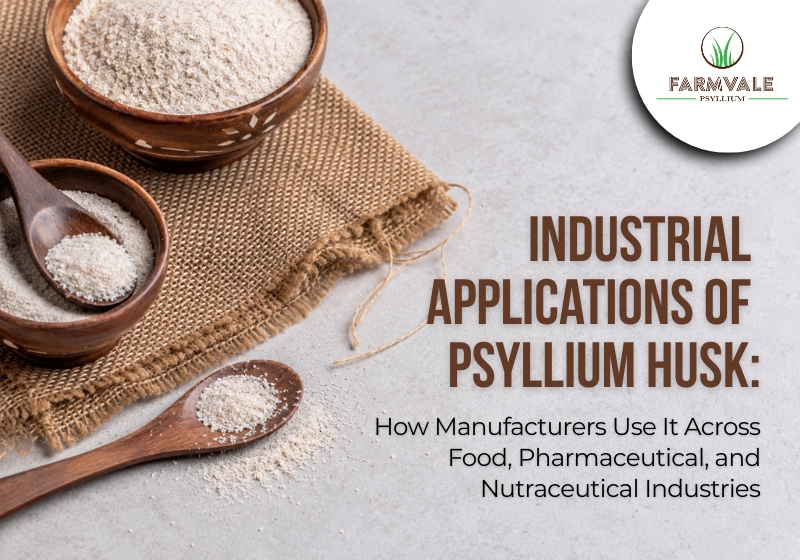
Industrial Applications of Psyllium Husk: How Manufacturers Use It Across Food, Pharmaceutical, and Nutraceutical Industries
Psyllium husk is valued for more than its health benefits. It improves product texture, stability, and shelf life. The growing clean-label trend has increased its popularity worldwide. Today, manufacturers use it to develop innovative products with natural ingredients and added value. This article explores the industrial applications of psyllium husk. It also explains why manufacturers consider it one of the most versatile agricultural ingredients in the global market.
As consumer demand shifts toward healthier, natural, and functional products, manufacturers across industries are actively seeking ingredients that deliver both nutritional benefits and technical functionality. One such ingredient that has gained significant global attention is psyllium husk.
Psyllium husk is a natural source of fiber that people have known about for a long time. But now, it’s used for a lot more than just that. It’s a key ingredient in making food, medicines, supplements, and even animal feed. It’s also used in some industrial applications. The reason it’s so useful is that it can hold a lot of water and form a gel-like texture, which makes it really good at providing soluble fiber. This makes it a crucial part of creating new products in many different fields.
A Functional Fiber with Diverse Applications
Psyllium husk is derived from the Psyllium seeds of Plantago ovata, a crop primarily cultivated in India, which accounts for the majority of global psyllium production and exports.
The outer husk of the seed contains exceptionally high levels of soluble dietary fiber. When exposed to water, the husk absorbs several times its own weight and forms a viscous gel-like substance. This unique characteristic is responsible for many of its industrial applications.
Applications of Psyllium Husk in the Food Industry
-
Gluten-Free Bakery Products
The largest single food-industry application is gluten-free baking, where psyllium functions as a structural surrogate for gluten. Psyllium improves dough viscosity, gas retention, and bread volume due to its water-binding and gelling properties. It also helps retain moisture and maintain softness during storage. These benefits enhance the texture, appearance, quality, and shelf life of gluten-free bread.
-
Meat and Processed Meat Products
In processed meat products such as sausages, frankfurters, meatballs, burgers, nuggets, and deli meats, maintaining a consistent texture is essential. Psyllium husk acts as a natural binder that helps hold ingredients together while improving the structural integrity of the product. The gel-forming properties of psyllium create a stable matrix within the meat formulation, which contributes to a firmer texture, improved sliceability, and enhanced mouthfeel. This is particularly important in products that undergo extensive processing, where texture stability can directly impact consumer acceptance.
Another important application of psyllium husk in the meat industry is fat reduction. As consumers become more health-conscious, demand for lower-fat meat products continues to grow. However, reducing fat often affects texture, juiciness, and overall eating quality. Its ability to retain water and create a smooth, gel-like consistency allows manufacturers to develop reduced-fat formulations without significantly compromising texture or palatability. As a result, producers can offer healthier meat products while maintaining the sensory characteristics consumers expect.
-
Pasta and Noodles
Psyllium husk powder is used in instant noodles and pasta to increase fiber content and improve the nutritional profile. Its inclusion helps improve the texture of noodles and pasta while boosting fiber content without affecting taste. In gluten-free pasta specifically, psyllium helps enhance texture and cooking properties and can mimic the gluten matrix found in bread.
This dual function — structural and nutritional — is what makes psyllium commercially attractive for pasta reformulation, particularly as manufacturers respond to consumer demand for high-fiber and gluten-free convenience foods.
-
Dairy Products – Ice cream and yogurt
In ice cream, psyllium husk functions as a natural stabilizer and thickening agent. Its ability to retain water helps control ice crystal formation during freezing and storage, resulting in a smoother and creamier texture. Psyllium also improves melt resistance and contributes to better body and mouthfeel, particularly in low-fat and reduced-calorie ice cream formulations where it can partially replace the textural benefits typically provided by fat. Additionally, it helps maintain product consistency and prevents phase separation, thereby extending shelf life and improving consumer acceptance.
In yogurt, psyllium husk is used to enhance viscosity, texture, and stability. It effectively reduces whey separation (syneresis), a common quality issue in yogurt products, by binding water within the protein matrix. This results in a thicker, creamier, and more uniform product. Furthermore, the soluble fiber content of psyllium increases the nutritional value of yogurt and supports digestive health, making it particularly suitable for functional and probiotic yogurt formulations. Its prebiotic potential may also contribute to the growth and activity of beneficial gut microorganisms.
Applications of Psyllium Husk in the Pharmaceutical Industry
-
Digestive Health Products
One of the most significant applications of psyllium husk in the pharmaceutical industry is its use in digestive health formulations. When consumed with water, psyllium expands and forms a gel-like mass in the digestive tract, helping to increase stool bulk and promote regular bowel movements. This natural mechanism has made psyllium a preferred ingredient in bulk-forming laxatives and fiber supplements used to support bowel regularity and digestive comfort.
Unlike stimulant laxatives, which may cause dependency with prolonged use, psyllium works naturally by supporting the body’s normal digestive processes.
-
Applications in Blood Sugar and Metabolic Health Products
-
Digestive Health Product – Fiber Intake
Pharmaceutical manufacturers also formulate psyllium into compressed tablets. These may be conventional fiber tablets, chewable tablets, or specialty formulations designed for digestive health support. Tablet formulations can present a challenge because fiber requires a relatively large dose. Manufacturers often produce larger tablets to accommodate the fiber content. In some cases, they recommend taking multiple tablets per serving.
Applications of Psyllium Husk in the Nutraceutical Industry
-
Dietary Fiber Supplements
Psyllium husk provides an excellent source of soluble fiber. Manufacturers commonly use it in powders, capsules, tablets, and sachets. These products help consumers increase their daily fiber intake. Its ability to absorb water and form a gel-like consistency within the digestive tract makes it particularly effective in supporting digestive regularity and maintaining gut health.
-
Digestive and Gut Health Products
Psyllium acts as a prebiotic fiber that can contribute to a balanced digestive environment while promoting regular bowel movements. Manufacturers include psyllium in gut health supplements, digestive support formulas, and colon wellness products. It also supports daily wellness programs that promote healthy digestion.
-
Applications in Meal Replacement and Wellness Drinks
Psyllium husk is frequently included in the formulations because of its ability to increase satiety and support digestive wellness. When consumed with liquid, psyllium expands and forms a gel-like consistency that can help create a feeling of fullness. This characteristic makes it particularly attractive for meal replacement shakes, weight management beverages, and nutritional drink mixes aimed at consumers seeking healthier lifestyle choices.
-
Applications in Nutrition and Health Bars
Manufacturers use psyllium husk in protein bars, meal replacement bars, fiber bars, and wellness snacks. It adds dietary fiber and helps maintain product texture and cohesion. Its water-binding properties help prevent excessive dryness and improve the overall eating experience. By incorporating psyllium, manufacturers can position their products as digestive-friendly and fiber-enriched solutions for health-conscious consumers.
Applications of Psyllium Husk in the Pet Food and Animal Feed Industry
-
Hairball Reduction in Cats
Psyllium husk is commonly used in feline nutrition to help manage and reduce the formation of hairballs. Cats naturally ingest hair while grooming, and excessive accumulation of hair in the digestive tract can lead to discomfort, vomiting, and digestive disturbances. Psyllium contains high levels of soluble fiber. It absorbs water and forms a soft gel in the digestive tract. Psyllium helps move trapped hair through the intestines. As a result, many horse owners regularly add it to their horses’ diets.
-
To improve anal Gland Health in Dogs
Psyllium husk is often included in canine nutrition formulations to support anal gland health through its ability to improve stool quality and consistency. Dogs naturally empty their anal glands when passing firm, well-formed stools. However, when stools are consistently soft or loose, the glands may not empty properly, leading to impaction, discomfort, inflammation, or infection.
As a rich source of soluble fiber, psyllium husk absorbs water in the digestive tract and forms a gel-like substance that helps increase stool bulk and improve stool firmness. The passage of adequately formed stools creates gentle pressure on the anal glands during defecation, promoting their natural expression and reducing the likelihood of gland-related issues.
-
Sand Colic Management in Horses: The Primary Equine Application
Applications of Psyllium Husk in the Construction and Industrial Industry
-
Adhesives and Binders
The mucilage present in psyllium husk exhibits excellent adhesive properties, making it suitable for use as a natural binder in various industrial formulations. Manufacturers incorporate psyllium-derived binders into eco-friendly adhesives, agglomerated products, and composite materials. These binders improve cohesion and binding strength. As a biodegradable plant-based material, psyllium offers a sustainable alternative to certain synthetic binding agents.
-
Ceramics and Foundry Applications
Psyllium husk can serve as a natural binding agent in selected ceramic and foundry formulations. Its organic binding properties help improve the handling and shaping characteristics of materials during manufacturing processes while offering a biodegradable alternative to synthetic additives.
-
Construction Materials
The construction industry uses psyllium husk as a natural thickening and binding agent in cement-based and gypsum-based formulations. Its ability to absorb large quantities of water helps improve water retention, workability, and consistency in construction mixtures. By controlling moisture distribution, psyllium-based additives can contribute to more uniform application and improved performance of construction materials.
Applications of Psyllium Husk in the Cosmetic and Personal Care Industry
-
Natural Thickening and Stabilizing Agent
Psyllium husk is utilized in cosmetic and personal care formulations for its excellent water-binding and gel-forming properties. When hydrated, psyllium forms a smooth, viscous gel that can act as a natural thickener and stabilizer in creams, lotions, gels, and serums. It helps improve product consistency, texture, and application characteristics while providing a plant-based alternative to synthetic thickeners.
-
Face Masks and Peel-Off Formulations
Due to its gel-forming capability, psyllium husk is particularly suitable for face masks and peel-off cosmetic products. It helps create a uniform film on the skin surface, allowing active ingredients to be distributed evenly. The resulting formulations provide a smooth application experience and can enhance the overall texture and stability of the product.
Conclusion:-
Psyllium husk has emerged as one of the most versatile and functional natural ingredients across multiple industries. Its exceptional water-binding, gel-forming, and fiber-enriching properties make it an indispensable ingredient in food manufacturing, pharmaceutical formulations, and nutraceutical products. Psyllium is a versatile functional ingredient. It improves texture and shelf life in many food products. It also supports digestive health and fiber enrichment. As a result, it is widely used across food, pharmaceutical, and nutraceutical industries.
As global markets increasingly shift toward clean-label, natural, and functional ingredients, the demand for high-quality psyllium husk continues to grow. At Farmvale Psyllium, we are committed to supplying premium-quality psyllium products that meet the stringent requirements of international food, pharmaceutical, and nutraceutical manufacturers. As a leading manufacturer and exporter of psyllium products from India, we are proud to be an EU GMP-certified supplier, ensuring the highest standards of quality, safety, traceability, and regulatory compliance. With our extensive industry expertise, advanced processing capabilities, and commitment to excellence, Farmvale Psyllium remains a trusted partner for businesses seeking reliable and sustainable psyllium solutions worldwide.