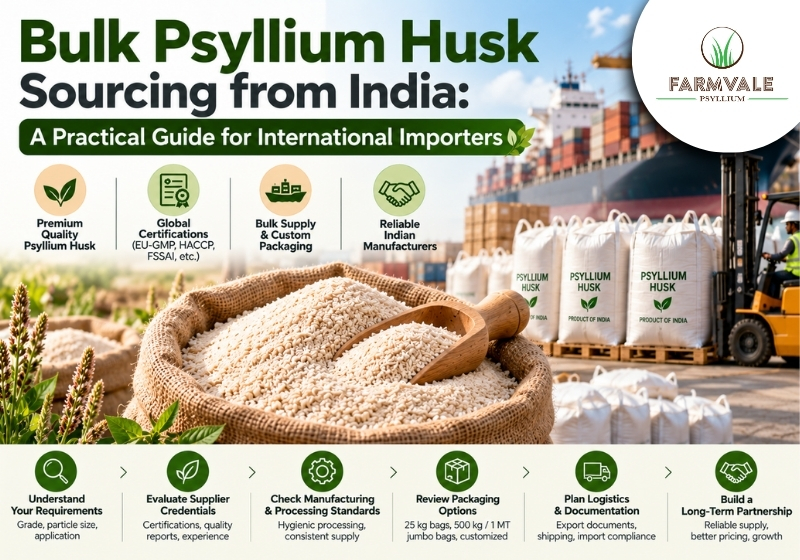
Bulk Psyllium Husk Sourcing from India: A Practical Guide for International Importers
Introduction
International buyers sourcing psyllium husk need more than a competitive quotation. Reliable procurement depends on a clear specification, representative samples, lot-level quality documentation, dependable capacity, traceability and an export process suited to the destination market. A structured supplier-evaluation process can reduce procurement risk.
Quick Answer
To source bulk psyllium husk from India, define the required grade and application, then compare suppliers on specification compliance, sample performance, COA quality, traceability, food-safety controls, capacity, packaging and export documentation. Confirm destination-market import and labeling requirements with the importer or customs specialist before shipment.
Why Buyers Consider Indian Psyllium Suppliers
India has an established psyllium cultivation, processing and export ecosystem. Buyers may evaluate suppliers for husk, powder and seeds, but capability and product suitability should be verified individually rather than assumed from origin alone.
Start with a Written Product Specification
Specify product form, purity and other quality parameters, particle size, moisture, microbiological limits, contaminant requirements, packaging, shelf life and intended use. Where methods matter, agree on test methods and acceptance criteria before placing a bulk order.
Sample Approval Before Commercial Orders
Request a representative sample and review appearance, odor, hydration behavior and performance in the intended formulation. For food, supplement or pharmaceutical applications, pair sample approval with analytical and regulatory review; visual inspection alone is not enough.
Documents and Traceability
Depending on product and destination, buyers may request a specification sheet, batch-specific COA, packing list, commercial invoice, origin documentation and applicable food-safety or conformity documents. The final list varies by market and classification. Check that lot numbers match across the COA, labels and shipping records.
Supplier Audit and Quality Controls
Evaluate the quality-management system, incoming-material checks, processing controls, laboratory arrangements, sanitation, pest control, traceability, deviation handling, complaints and recall procedures. Audit depth should reflect intended use and risk.
Packaging, Logistics and Communication
Confirm pack size, packaging material, palletization, container loading, storage conditions, shipping terms, lead times and communication points for delays or document corrections. Agree on how damaged packaging, quality deviations and claims will be handled.
Avoid Common Sourcing Mistakes
Do not compare quotations without aligning specifications. Do not assume a sample represents every future lot without ongoing controls. Avoid vague quality promises, unclear change-notification practices or missing lot traceability. Confirm regulatory requirements before dispatch.
Farmvale Psyllium
Farmvale Psyllium supplies psyllium ingredients for international buyers. Importers can share intended application, destination market, target specification, packaging and forecast volumes to help determine the appropriate product and documentation package.
FAQs
- What should I ask a bulk psyllium supplier in India?
Ask for the specification, sample, COA, traceability information, quality-system documents, production capacity, packaging details and export experience. - Is the lowest quote the best option?
Not necessarily. Compare quotations against the same specification and assess consistency, documentation, service and logistics risk. - Which documents are needed for import?
The exact list depends on product classification and destination rules. Confirm it with the importer and customs broker. - Should I approve a sample before ordering bulk?
Yes. Sample evaluation helps assess application performance, supported by quality documentation.