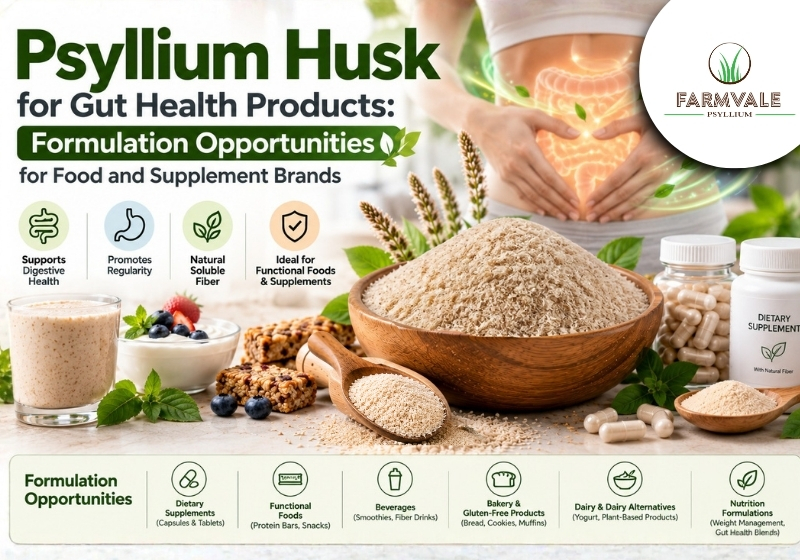
Psyllium Husk for Gut Health Products: Formulation Opportunities for Food and Supplement Brands
Introduction
Gut-health positioning is an important innovation theme across functional foods, beverages and supplements. Product developers must balance a meaningful nutrition proposition with taste, texture, convenience and reliable ingredient quality. Psyllium husk is one ingredient brands may evaluate for fiber-focused products, provided its hydration behavior and intended use are validated.
Quick Answer
Psyllium husk is a fiber-rich ingredient that can be considered for selected gut-health and fiber-focused foods or supplements. Its water-binding and gel-forming properties may affect texture, viscosity and processing, so developers should choose a suitable grade and test the finished formulation. Health claims must be reviewed against the rules of the target market.
Why Gut Health Is a Product Innovation Theme
Consumers increasingly connect digestive wellness with broader wellbeing, and food-industry trend reporting continues to identify fiber and gut health as important innovation areas. Brands can explore convenient products that deliver fiber in familiar formats, while ensuring the final product meets consumer expectations for taste and usability.
What Psyllium Brings to a Formulation
Psyllium husk comes from the outer covering of Plantago ovata seeds. It is rich in dietary fiber and absorbs water, forming a viscous gel. These properties can be useful in some formulations, but can also change thickness, mouthfeel, dispersion and stability. Testing is essential, particularly for beverages and powdered mixes.
Product Formats to Explore
- Fiber drink mixes: evaluate hydration time, dispersion, viscosity and preparation instructions.
- Powdered nutrition blends: test flow, blend uniformity and moisture control.
- Bars and snacks: explore fiber enrichment while checking texture, binding and shelf-life performance.
- Bakery products: assess structure, moisture retention and sensory qualities.
- Other functional foods: consider psyllium where the product concept and process can accommodate its hydration properties.
Formulation Questions to Answer Early
Determine the intended fiber contribution, serving size, hydration behavior, sensory limits, processing sequence, packaging requirements and shelf-life goals. Establish how the ingredient will disperse and whether consumers need preparation instructions.
Claims and Regulatory Review
An ingredient’s characteristics do not automatically permit a finished-product health claim. Claim eligibility, wording, evidence and labeling rules vary by country and product category. Regulatory review should happen before packaging artwork or marketing copy is finalized.
How to Qualify a Indian Psyllium Supplier
Request a product specification, representative sample, lot-specific certificate of analysis, traceability information and applicable food-safety documentation. Review purity, particle size, moisture, microbiological parameters and contaminant controls according to the application and destination market.
Farmvale Psyllium
Farmvale Psyllium supplies psyllium ingredients for international buyers. Brands developing fiber-focused products should discuss intended application, target specifications, packaging and destination-market documentation before confirming a commercial grade.
FAQs
- Is psyllium husk used in gut-health products?
It can be considered in fiber-focused foods and supplements, subject to formulation and regulatory requirements. - Does psyllium change beverage texture?
Yes. Its water-binding and gel-forming behavior can increase viscosity, so dispersion and sensory testing are important. - Can brands make digestive-health claims because a product contains psyllium?
Not automatically. Claims must meet applicable rules and evidence requirements. - What should a buyer request from a supplier?
Request a specification, sample, COA, traceability information and relevant quality documentation.