Organic Psyllium Husk: What Global Buyers Should Verify Before Choosing a Certified Supplier
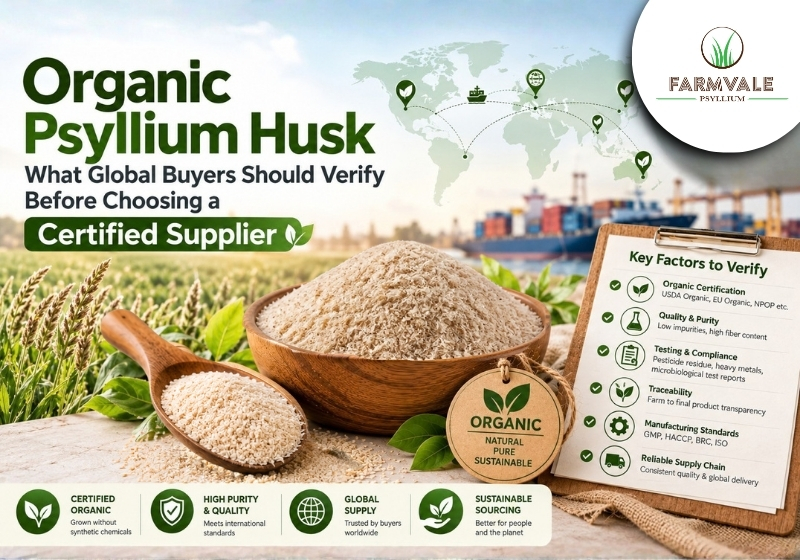
When buying organic psyllium husk, verify the certification program, certified operation, product scope, certificate validity, lot traceability, handling controls and documentation required for your destination market. In the United States, the National Organic Program governs USDA organic labeling. Buyers should also verify organic requirements for other regulated markets.
Organic Is a Certification Status, Not Just a Marketing Description
Words such as natural, clean-label and plant-based do not automatically mean organic. For the U.S. market, USDA states that organic products must be produced and handled according to organic regulations and that organic certification allows an operation to sell, label and represent products as organic.
What Should Buyers Check on an Organic Psyllium Certificate?
Check the legal name and address of the certified operation, certification body, scope of certification, validity dates and applicable product category. The psyllium product being purchased should fall within the certification scope. Buyers should also maintain documentation connecting the supplied lot with the certified operation and transaction.
USDA Organic Considerations for U.S. Buyers
USDA organic labeling has defined categories. A finished product labeled Organic generally requires at least 95% certified organic ingredients, while Made with organic ingredients follows a different threshold and labeling framework. The USDA seal is not permitted for products in the Made with organic category. Imported organic products must also follow applicable USDA requirements.
Why Traceability Matters
Organic supply chains depend on maintaining separation and preventing commingling with non-organic material. Buyers should ask how organic raw materials are identified, stored, processed, packed and documented. Lot numbers and audit-trail information should connect the physical material with supporting records.
Organic Psyllium Quality Still Needs Conventional Quality Controls
Organic certification does not replace ingredient quality testing. Buyers should still define requirements for botanical identity, purity, moisture, microbiological quality, contaminants, pesticide controls where applicable, foreign matter, particle size and other application-specific characteristics.
Questions to Ask an Organic Psyllium Supplier
Can you provide the current organic certificate? Is the psyllium product included in the certificate scope? Which certification program applies to my destination market? Can you provide lot-level traceability? What testing is performed? How is organic material segregated? What shipment documents are available? Can your quality team support label and compliance reviews?
Organic Psyllium for Clean-Label Product Development
Certified organic psyllium can be relevant to organic bakery, fiber products, functional foods, dietary supplements and other formulations where organic sourcing is part of the product proposition. The final product’s organic claim must still comply with the destination market’s labeling rules.
Farmvale Psyllium
Farmvale Psyllium supplies psyllium ingredients for international buyers and can support discussions around product specifications, documentation and destination-market requirements. Buyers should request the current certification and product documentation applicable to the specific order.
FAQs
- Is organic psyllium the same as natural psyllium?
No. Natural is a broad description, while certification and labeling rules govern organic claims in regulated markets. - What should a U.S. buyer request?
Review the applicable USDA organic certification, product scope, lot traceability and documentation needed for the intended use and label claim. - Can manufacturers use organic psyllium in supplements?
It can be an ingredient in supplement products, but the finished product must comply with applicable organic and supplement requirements. - Does organic certification guarantee every quality parameter?
No. Buyers should separately evaluate identity, purity, microbiological, contaminant and application-specific requirements. - Why is lot traceability important?
It helps connect the physical shipment to the certified supply chain and supporting quality and audit records.