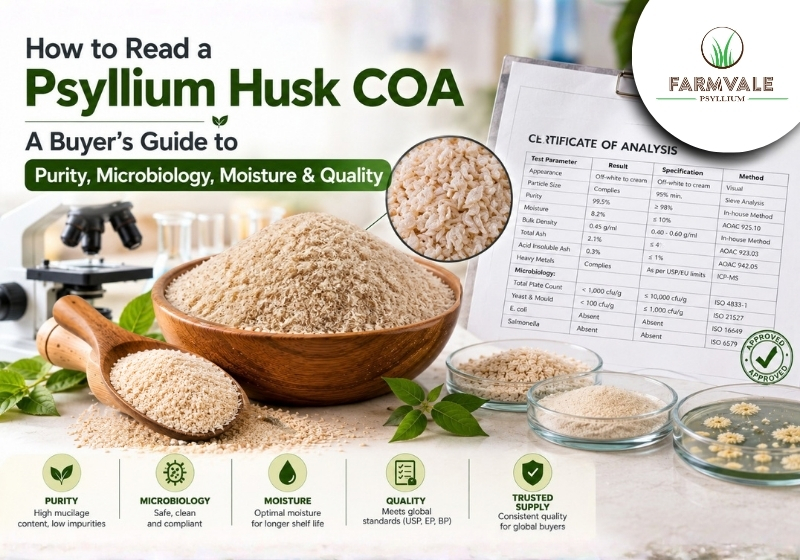
How to Read a Psyllium Husk COA: A Buyer’s Guide to Purity, Microbiology, Moisture & Quality
A psyllium husk COA should be reviewed against the buyer’s approved specification, not judged by one number such as purity. Key areas can include product identity, purity, moisture, particle size or mesh, microbiological parameters, contaminants, pesticide or heavy-metal controls where applicable, physical characteristics and lot identification.
What Is a COA?
A Certificate of Analysis is a quality document reporting analytical or inspection results for a defined product lot. In a professional B2B supply chain, the COA should be linked to the product name, batch or lot number and relevant specification. Buyers should check that the document is consistent with the shipment and agreed purchase requirements.
1. Product Identity
The COA should clearly identify the correct material: psyllium seeds, psyllium husk, husk powder or another psyllium-derived product. Botanical identity and product description should match the purchase order and approved specification.
2. Purity
Purity is one of the headline parameters for psyllium husk. Buyers should understand the supplier’s test method, product grade and specification before comparing percentages. A higher stated purity is not automatically the best choice for every application.
3. Particle Size and Mesh
Particle size can influence hydration, dispersion, texture, flow and processing behavior. Different applications may require different mesh ranges. Buyers should define the target particle-size specification before commercial production.
4. Moisture
Moisture can affect storage stability, handling and processing behavior. The acceptable range should be established in the agreed product specification. Packaging, storage conditions and transport duration should also be considered.
5. Microbiological Parameters
For food and supplement applications, microbiological quality is a key part of ingredient qualification. The required parameters and limits should be based on the destination market, product category, intended use and buyer’s food-safety system.
6. Heavy Metals, Pesticides and Other Contaminants
Depending on market and application, buyers may require testing or compliance documentation for heavy metals, pesticide residues, foreign matter and other contaminants. The relevant list should be based on regulatory and customer requirements.
7. Lot Traceability
A strong COA should connect to a specific lot or batch. Buyers should compare the lot number on the COA with the bags, packing list and other shipment records. Traceability becomes particularly important when a buyer operates a formal supplier-approval and recall system.
8. COA Is Not the Same as Supplier Qualification
A COA confirms reported characteristics for a lot; it does not by itself prove that the supplier has an adequate quality-management system. Additionally, supplier qualification may involve certifications, audit information, manufacturing controls, complaint history, change management, and ongoing performance monitoring.
A Practical COA Review Workflow
>Step 1: Match product name and grade to the purchase order.
>Step 2: Verify lot number and production information.
>Step 3: Compare every reported result with the approved specification.
>Step 4: Check units and test methods where relevant.
>Step 5: Review microbiological and contaminant requirements.
>Step 6: Confirm traceability and supporting documents.
>Step 7: Escalate unexplained deviations before shipment approval.
Farmvale Psyllium
Farmvale Psyllium works with international buyers requiring defined psyllium specifications and export documentation. Beforehand, buyers can establish the required quality parameters before sampling or placing a commercial order, ensuring that the COA is evaluated against a clear, application-specific specification.
FAQs
- What should a psyllium COA contain?
It should identify the product and lot and report agreed quality parameters relevant to the product and application. - Is 99% purity always better?
Not necessarily. The appropriate specification depends on the application, regulatory requirements and technical performance needed. - Why does mesh size matter?
Particle size can influence hydration, dispersion, texture, flow and processing behavior. - Can I approve a supplier based only on a COA?
No. Supplier qualification should consider the broader quality system, documentation, traceability and performance history. - Should buyers test the supplier’s sample?
For new suppliers or new applications, independent or buyer-side testing and formulation trials can provide additional confidence before bulk approval.