Psyllium Husk vs Psyllium Husk Powder vs Psyllium Seeds: Which Format Should Buyers Choose?
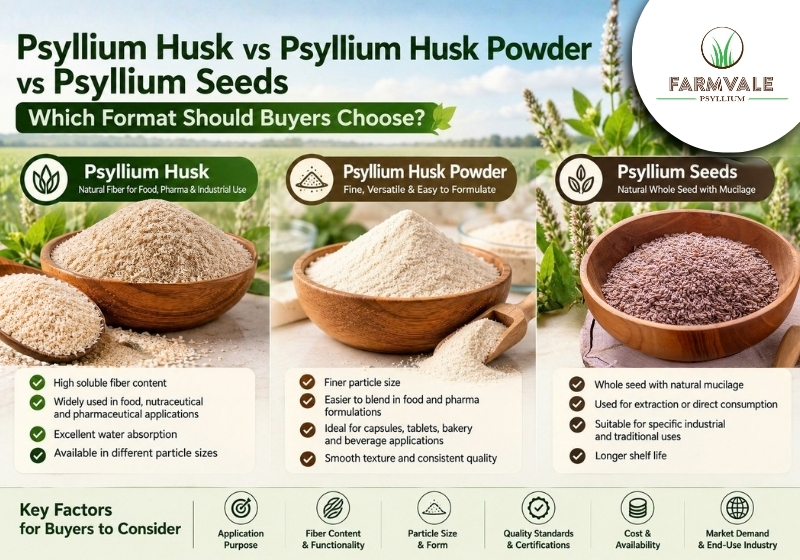
Psyllium seeds are the raw botanical material from which the husk is separated. Whole psyllium husk is the cleaned seed coat and is commonly selected when an application benefits from its fiber structure and hydration behavior. Psyllium husk powder is a milled form that can offer controlled particle size and easier incorporation into some formulations. The right format depends on the application, process and specification.
What Are Psyllium Seeds?
Psyllium seeds are the whole seeds of Plantago ovata. They are the starting material for producing psyllium husk and other processed forms. Buyers purchasing seeds may be processors or manufacturers with their own cleaning and processing capabilities.
What Is Whole Psyllium Husk?
The husk is the seed coat separated from the psyllium seed. It is a concentrated source of soluble fiber and has strong water-binding and gel-forming behavior. Whole husk can be useful where the physical structure and hydration characteristics of the ingredient are desired.
What Is Psyllium Husk Powder?
Psyllium husk powder is produced by milling husk to a specified particle size. Powder can be useful when a formulation requires controlled dispersion, particle size or incorporation into a blended ingredient system. Different mesh sizes can behave differently, so buyers should evaluate the exact specification.
Which Format Is Suitable for Food Manufacturing?
Bakery and gluten-free formulations may use whole husk or powder depending on desired texture, hydration rate and processing. Beverage and dry-mix applications may prefer a powder with controlled particle size for dispersion. The final choice should be validated through bench testing.
Which Format Is Suitable for Nutraceutical Products?
Fiber sachets, drink mixes, capsules and other supplement formats can require different grades and particle sizes. Packaging, flowability, dispersion, serving size and consumer experience should be considered alongside purity and microbiological specifications.
Which Format Is Suitable for Pharmaceutical Applications?
Pharmaceutical manufacturers generally specify the exact ingredient characteristics required for their formulation and quality system. Buyers should not select a grade solely because suppliers market it as pharmaceutical. Buyers should assess the supplier’s qualifications, specifications, analytical data, manufacturing controls, and regulatory suitability.
How Purity and Mesh Work Together
Purity and particle size answer different questions. Purity describes composition or quality under the supplier’s stated method, while mesh or particle size describes physical dimensions. A buyer can need both a defined purity and a specific particle-size range for consistent formulation performance.
How to Select the Right Psyllium Format
Define the finished-product application first. Then specify hydration behavior, particle size, purity, microbiological limits, contaminant controls, packaging, shelf life and regulatory documentation. Request samples of the proposed grade and compare them under realistic processing conditions.
A Simple Buyer Decision Framework
Choose seeds when you need raw botanical material for further processing. Consider whole husk when you want the cleaned fiber ingredient with its natural husk structure. Consider powder when controlled particle size and incorporation into a formulation are more important. In all cases, validate the actual grade before scaling up.
Farmvale Psyllium
Farmvale Psyllium supplies psyllium seeds, husk and powder for international buyers. Customers can select the appropriate format based on their application, specification, processing requirements, and destination-market documentation needs.
FAQs
- Are psyllium seeds and psyllium husk the same product?
No. Seeds are the whole botanical seed, while husk is the separated seed coat. - Is psyllium powder better than whole husk?
Neither is universally better. The appropriate format depends on formulation and processing requirements. - Does mesh size affect psyllium performance?
Yes. Particle size can influence hydration, dispersion, texture and processing behavior. - Can the same psyllium grade be used for every application?
Not necessarily. Food, nutraceutical, pharmaceutical and industrial applications can require different specifications. - What should I ask a supplier before ordering?
Request the product specification, sample, COA, particle-size information, relevant quality documents, packaging details and destination-market documentation.