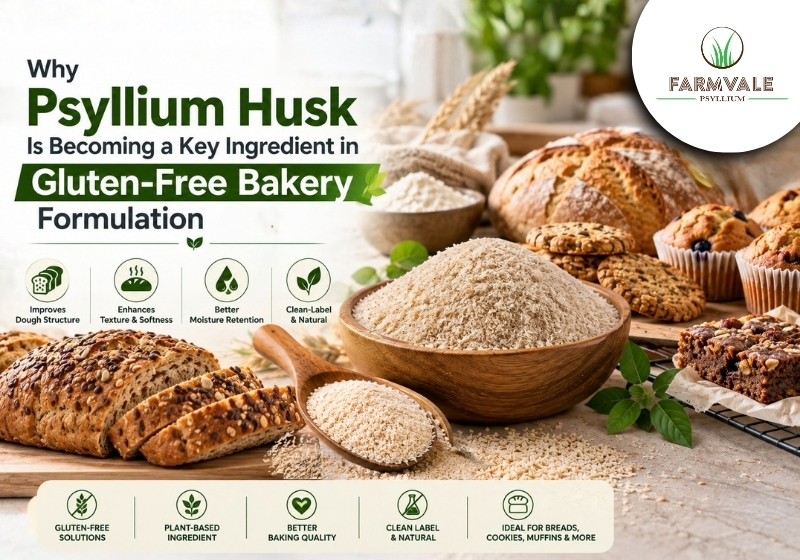
Why Psyllium Husk Is Becoming a Key Ingredient in Gluten-Free Bakery Formulation
Psyllium husk can support gluten-free bakery formulations by contributing water binding, gel-forming behavior, moisture management and dietary fiber. It is especially relevant to breads, rolls, wraps, pizza bases, crackers and other gluten-free products where developers need to balance structure, softness, handling and nutrition. The correct grade and inclusion level should always be established through formulation trials.
Why Gluten-Free Bakery Needs Functional Ingredients
Removing wheat gluten changes dough behavior. Gluten-free systems generally require a combination of flours, starches, fibers, hydrocolloids and other functional ingredients to achieve desirable structure and eating quality. Psyllium is not a one-for-one replacement for gluten; it is one functional component that can help a broader formulation system.
How Psyllium Works in Gluten-Free Dough
Psyllium husk has a strong affinity for water and can form a viscous gel. In a suitable formulation, this can help bind water, improve dough cohesion and contribute to moisture retention. Performance depends on purity, particle size, hydration level, mixing conditions, baking process and the other ingredients in the recipe.
Where Can Manufacturers Use Psyllium?
Gluten-free bread can use psyllium to support dough cohesion, moisture management and crumb structure. Wraps and flatbreads can benefit from improved binding and flexibility. Pizza bases may use it to support a cohesive dough system. Crackers and baked snacks can use it when fiber enrichment and structure are desired. Selected breakfast and functional bakery products can also be evaluated through controlled trials.
Psyllium and the Clean-Label Opportunity
Bakery innovation in 2026 is increasingly influenced by health, wellness, clean-label and plant-based positioning. Industry reporting highlights the importance of texture, taste and nutrition alongside cleaner ingredient concepts. Psyllium can contribute both functional performance and a recognizable plant-derived fiber story, although every brand should define its own clean-label standard.
Important U.S. Gluten-Free Labeling Consideration
For foods marketed with a gluten-free claim in the United States, FDA rules require the food to contain less than 20 parts per million of gluten and to meet the other requirements of the regulation. Ingredient selection alone does not establish a gluten-free finished product; manufacturers also need appropriate controls for cross-contact and verification.
How to Select the Right Psyllium for Bakery
Compare purity, particle size or mesh, hydration behavior, microbiological specifications, moisture, contaminant controls, packaging and batch consistency. Bench testing is important because ingredients with similar headline specifications can behave differently in a finished dough system.
Formulation Testing Checklist
A practical development program can measure water absorption, dough handling, mixing time, proofing behavior, loaf volume, crumb structure, moisture retention, sliceability, sensory properties and shelf-life performance. Test several inclusion levels rather than assuming one standard dosage works across recipes.
Why Supplier Documentation Matters
A bakery ingredient supplier should provide an agreed specification, lot-specific certificate of analysis and relevant food-safety and traceability information. For gluten-free applications, buyers may also require supplier statements, analytical evidence or other controls appropriate to their risk-management system.
Farmvale Psyllium
Farmvale Psyllium supplies psyllium ingredients for international food applications. For gluten-free bakery development, buyers can match the required grade and specification to the formulation, testing protocol and destination-market requirements.
FAQs
- Can psyllium replace gluten in gluten-free bread?
No. Psyllium can support structure and water management, but gluten-free products normally require a complete formulation system designed for the absence of gluten. - Why is psyllium useful in gluten-free baking?
Its water-binding and gel-forming behavior can contribute cohesion, moisture management and texture, while also providing dietary fiber. - Does psyllium make a product automatically gluten-free?
No. A finished product must meet applicable gluten-free requirements and be controlled for cross-contact. - Which psyllium form is best for bakery?
The appropriate form depends on the recipe, desired texture, processing conditions and target specification. - How should a manufacturer test psyllium before bulk purchase?
Request a representative sample and COA, then conduct controlled bench trials using the same processing conditions planned for commercial production.