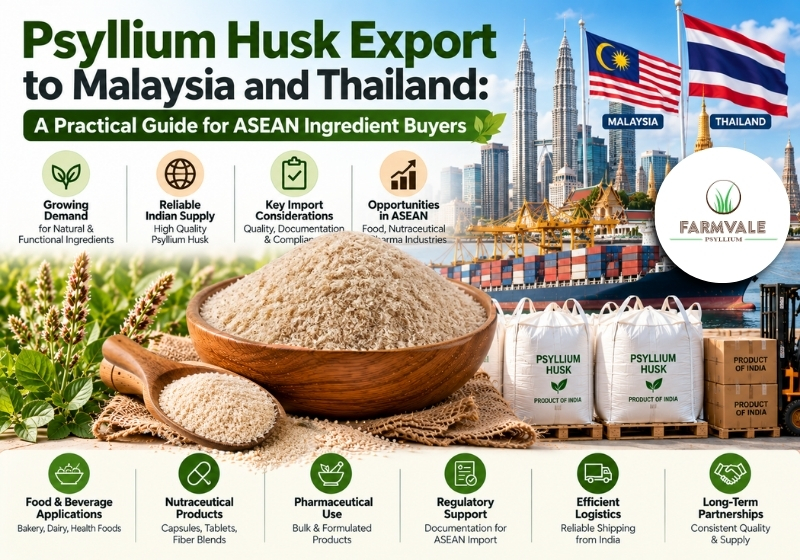
Psyllium Husk Export to Malaysia and Thailand: A Practical Guide for ASEAN Ingredient Buyers
Introduction
Malaysia and Thailand are distinct regulatory markets, even though both are part of ASEAN. Buyers sourcing psyllium husk from India should use a shared supplier-qualification process while confirming country-specific import, food-safety, labeling and customs requirements separately.
Quick Answer
For psyllium husk exports from India to Malaysia and Thailand, define the product and intended use, approve a written specification and sample, verify lot-specific quality documents, and confirm each country’s import, food-safety, labeling and customs requirements separately. Requirements vary by classification and use, so consult the local importer and competent authority before dispatch.
Why the Two Markets Need Separate Checks
Both markets have their own competent authorities, import processes and labeling rules. Requirements may differ depending on whether psyllium is a conventional food ingredient, supplement ingredient or another product category. Approval in one country does not automatically apply to the other.
Build a Shared Supplier Qualification File
Collect the product specification, sample evaluation, batch-specific COA, traceability information, relevant food-safety documents, packaging details and supplier quality information. Maintain a shared supplier file but add country-specific checklists for each shipment.
Malaysia: Import and Labeling Preparation
Confirm the product classification and relevant Malaysian regulatory pathway with the importer. Review applicable import permits or approvals, customs documentation, food-safety expectations and labeling requirements. Check the final label for the product category and applicable rules.
Thailand: Import and Labeling Preparation
Confirm requirements with the Thai importer and relevant authorities, including the Thai FDA where applicable. Product category can affect import licensing, registration or notification, label review and documentation. Verify current requirements before dispatch.
Quality Parameters for Both Markets
Agree on identity, purity, particle size, moisture, microbiological parameters, contaminants, packaging and shelf-life requirements. Check the COA against the approved specification and ensure lot numbers match across the shipment documents.
Logistics and Commercial Planning
Confirm shipping terms, pack sizes, lead times, transport arrangements, document deadlines, customs broker responsibilities and procedures for discrepancies. Forecast planning and written change-notification rules help reduce disruptions.
How to Choose an Export Partner
Evaluate technical consistency, capacity, traceability, export experience, responsiveness and coordination with local importers. Ask how the supplier handles document corrections, deviations and specification changes.
Farmvale Psyllium
Farmvale Psyllium supplies psyllium Products for international markets. Buyers in Malaysia and Thailand can share product category, intended use, specification, packaging and local import checklists to align product and export documents.
FAQs
- Can one psyllium shipment be planned for both countries?
Possibly, but each destination’s requirements, labeling and import documents must be checked separately. - Do Malaysia and Thailand have identical food-import rules?
No. Each market has its own authorities and requirements. - What should buyers request from an Indian exporter?
A specification, lot-specific COA, traceability information, relevant quality documents and shipment records. - Should labels be reviewed before printing?
Yes. Country-specific label review can help avoid costly corrections. - When should import requirements be checked?
Before commercial production and shipment, with a final verification before dispatch.